
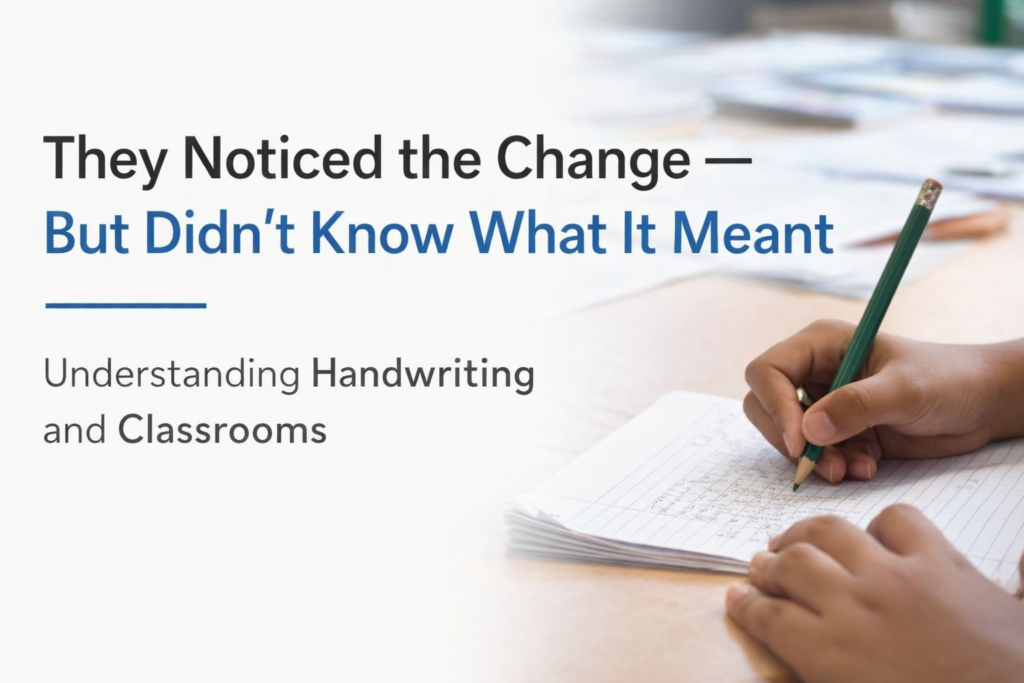
A recent poll asked educators a simple question: “Have you ever noticed a student’s handwriting change during stressful phases?”
The response was telling. Most said yes. Very few said no. Some admitted they had never paid attention—until now.
This tells us something important.
Teachers Are Observant — But Underequipped
Teachers notice far more than they are given credit for.
They notice when:
-
Confident handwriting suddenly becomes shaky
-
Letters shrink, spacing tightens, or pressure increases
-
Work becomes rushed, inconsistent, or unusually messy
-
A previously neat student starts avoiding written tasks
Yet, what usually follows these observations?
“Exam stress.” “Lack of practice.” “Carelessness.” “It’s just a phase.”
These explanations are not wrong—but they are often incomplete.
Handwriting Is Not Just a Motor Skill. It’s Mind in Motion.
Handwriting is one of the few activities where mind, emotion, and body work together in real time.
When a child is anxious, overwhelmed, emotionally withdrawn, or under pressure, it often shows up on paper before it shows up in behaviour or speech.
Handwriting changes can reflect:
-
Emotional overload
-
Fear of failure
-
Performance pressure
-
Low confidence
-
Suppressed expression
-
Mental fatigue
The handwriting is not the problem. It is the signal.
The Gap: Seeing vs Understanding
Most educators already see these changes. What’s missing is the language and framework to interpret them correctly.
Without that understanding:
-
Emotional distress gets mislabelled as laziness
-
Pressure gets mistaken for a lack of discipline
-
Silent struggles remain invisible
This is not a failure of teachers. It’s a training gap.
What Handwriting Analysis Actually Offers
Handwriting analysis does not replace psychology, counselling, or teaching skills. It supports them.
It helps educators:
-
Understand emotional patterns without intrusive questioning
-
Identify early stress indicators
-
Respond with empathy instead of assumption
-
Support students before issues escalate
It turns intuition into informed awareness.
The Real Question
The poll shows us one thing clearly:
Educators are already noticing. Students are already communicating.
The real question is:
Are we equipped to listen to what handwriting is trying to say?
Because when teachers learn to interpret what they already observe, support becomes deeper, earlier, and far more effective.
And sometimes, that makes all the difference.
#handwritinganalysis #handwritingmatters #schoolcounsellor #studentwellbeing #classroominsights #emotionallearning #mindfuleducation #meerakii #faridabharmal