
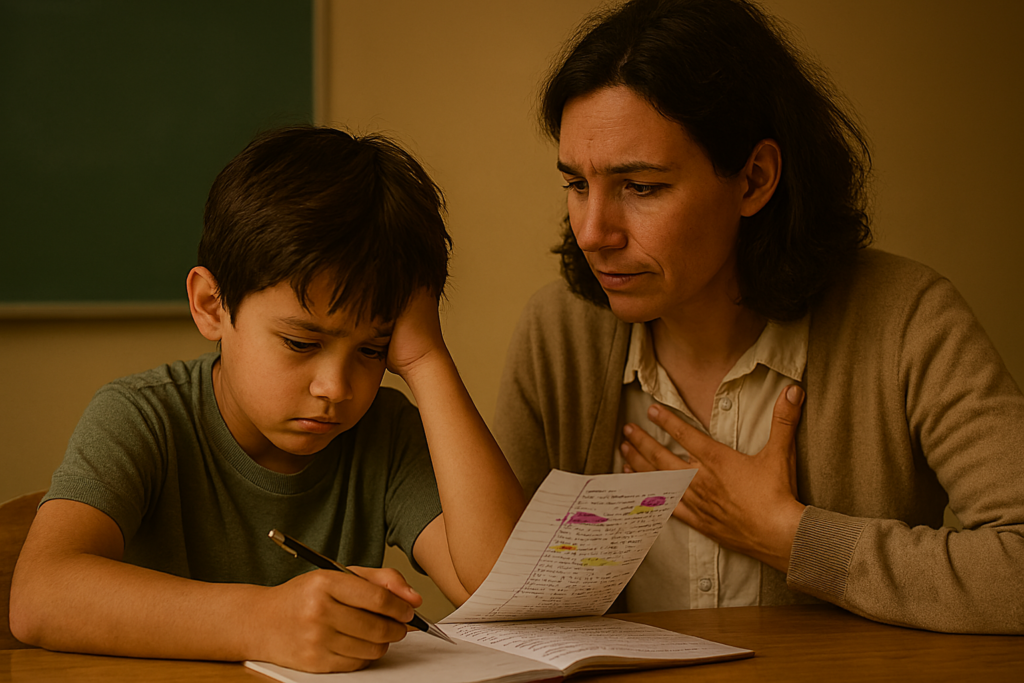
Every struggling student has a story — but most aren’t able to speak it.
The Hidden Foundation: Emotional Well-Being
As a graphologist, counsellor, and mindset coach deeply with students and professionals, I’ve learned one truth: students rarely say “I’m stressed.” More often, they express it quietly — through their handwriting, mood, behaviour, or silence.
Shrinking letters, fading pressure, uneven baseline, or a leftward slant in handwriting are sometimes early emotional red flags — long before grades drop or behaviour issues begin to show. These subtle signals often go unnoticed when the focus remains purely on academic results.
Scientific research supports this observation: emotional and mental health are deeply connected to learning outcomes. For instance, impaired mental health among students significantly increases the risk of poor academic performance over time. PMC+2Academic Strive+2
Conversely, students with better emotional-wellbeing and emotional regulation tend to show stronger motivation, better concentration, and greater resilience — factors that support not just academic performance, but overall development. Study+2Amrapali Institute+2
Schools, Counsellors & the Pressure of Academics
In many educational institutions, academic success and extracurricular achievement are the primary focus. More often than not, schools, parents, and even students themselves judge success based on marks and outward performance.
In this high-pressure environment, emotional distress may remain hidden — ignored until it turns into behavioural issues, drop in performance, or mental health crises. Waiting until the crisis emerges makes intervention harder and more reactive.
That’s where the role of counsellors, emotional-intelligence advocates, and graphologists becomes crucial. When counsellors and educators can identify emotional challenges early — even through handwriting changes or subtle signs — they provide an opportunity for prevention rather than waiting for a breakdown.
Beyond individual counselling, schools can create a supportive ecosystem: safe spaces for sharing, emotional-awareness sessions, regular check-ins, and integrating emotional literacy into the school culture. Such an environment reduces stigma, increases trust, and encourages students to open up.
Why Emotional Awareness Should Be the Starting Point
-
Prevents mental-health issues from escalating: Early detection of emotional distress — before grades or behaviour worsen — helps in timely intervention.
-
Supports long-term learning and growth: Emotional stability fosters motivation, self-confidence, resilience — essential traits for lifelong learning, not just exam success.
-
Builds a holistic approach to education: Recognizes students as whole beings — not just learners. Emotional well-being enables healthy relationships, self-understanding, and balanced development.
-
Reduces dropouts and disengagement: Students facing emotional turmoil often lose focus or give up — addressing emotional health can keep them engaged, motivated, and confident.
The Role of Counsellors & Graphology in This Journey
As a counsellor and graphologist, I believe our role isn’t to judge or control — but to understand. Here’s what we can do:
-
Observe subtle signs (like changes in handwriting, mood, participation) that may indicate emotional struggle.
-
Provide a safe, non-judgmental space for students to express feelings. Sometimes they don’t know how to verbalise; they only need someone who listens — and understands beyond the surface.
-
Work with parents and teachers to create a supportive environment — one that values emotional health as much as academic performance.
-
Advocate for emotional literacy: incorporate emotional awareness, stress management, self-expression — in curricula, counselling sessions, school culture.
Call to Educators, Counsellors and School Leaders
Let’s not wait for a student to fail grades, shut down, or act out — before we ask “What’s wrong?”
Emotional understanding must come first. Because when we understand the heart, the mind learns far better.
💬 I’d love to hear from you — educators, counsellors, parents. What experiences have you had where emotional support changed a student’s learning journey? Or where emotional distress remained hidden until it was too late? Please share.
Let’s start a conversation — because awareness is the first step toward lasting change.
#meerakii #faridahbharmal #teachersofindia #counsellorsofindia #educators #graphology #emotionalwellbeing #schools